

Thursday, October 28, 2010
Tuesday Bassen's "Studio Sweet Studio" zine
Tuesday put together this nifty little zine about artists and their studios. Printed on the SB's Konica Bizhub c650 on Hammermill Fore MP Colors Grey paper.

Tuesday, October 12, 2010
Wednesday, April 28, 2010
SB Cards Expiring // Lower Prices Coming!

The Service Bureau will be introducing a new pricing structure for Fall'10. We are working hard to offer our services and supplies at the best prices we can - all ON CAMPUS!
We are still working out the details but please be advised that ALL CURRENT SB CARDS WILL EXPIRE OVER THE SUMMER. Beginning Fall'10 there will be new SB Cards issued and all old ones will be invalid. In other words, you won't be able to use the old cards to pay for SB services come fall semester.
So - be mindful with your SB Card purchases until the end of this semester and if you're leaving campus for the summer or graduating, use those credits up, or sell them to someone who can use them!
When we have specifics on the date of the actual implementation and expiration of old cards, we will let you know well in advance.
As always, thank you for your patronage and support!
Monday, April 19, 2010
Sarah Kissell's "Still Remains - The Immortal Cycle of an Icon: Jacqueline Kennedy Onassis"
Check out part of recent alum Sarah Kissell's senior project: a tribute to Jackie O and 60's fashion wrapped up in an elegant book package that celebrates the style of the 1960's.


Sarah's dedication, attention to detail and perfection in her craft resulted in a gorgeous book. Sarah now works as a designer at Urban Outfitters.


Sarah's dedication, attention to detail and perfection in her craft resulted in a gorgeous book. Sarah now works as a designer at Urban Outfitters.
Tuesday, March 23, 2010
Jacey Braband's Google Book and Mai Hoa Salon Identity
Award for the thickest book we've ever bound goes to Jacey Braband's "Meaning of Life/Google Book." It is nearly 2 inches thick and makes extensive use of half-gatefold dividers, several paper stocks and a metallic silver cover. Check out this impressive tome!


Jacey also gets points for innovation with her Mai Hoa Salon identity system. She utilized the Konica c650 to double print different parts of her design to create the appearance of a gloss spot-varnish. This is a good example of experimentation with process and materials and of exploiting what seems like a limiting technology (laser printing) to achieve sophisticated looking results.


Jacey also gets points for innovation with her Mai Hoa Salon identity system. She utilized the Konica c650 to double print different parts of her design to create the appearance of a gloss spot-varnish. This is a good example of experimentation with process and materials and of exploiting what seems like a limiting technology (laser printing) to achieve sophisticated looking results.

Tuesday, February 16, 2010
What the Heck is a Giclée Print?!
You may have heard people talk about "Gicée Prints" or occasionally have a client ask for one. I'll confess, the first time I heard this term I assumed it meant some type of special printing process since it sounded fancy.

The word "giclée" is derived from the French language word "le gicleur" meaning "nozzle", or more specifically "gicler" meaning "to squirt, spurt, or spray"[1]. It was coined in 1991 by Jack Duganne,[2] a printmaker working in the field, to represent any inkjet-based digital print used as fine art. The intent of that name was to distinguish commonly known industrial "Iris proofs" from the type of fine art prints artists were producing on those same types of printers. The name was originally applied to fine art prints created on Iris printers in a process invented in the early 1990s but has since come to mean any high quality ink-jet print and is often used in galleries and print shops to denote such prints.

(Info referenced from http://en.wikipedia.org/wiki/Giclée)
Thursday, February 11, 2010
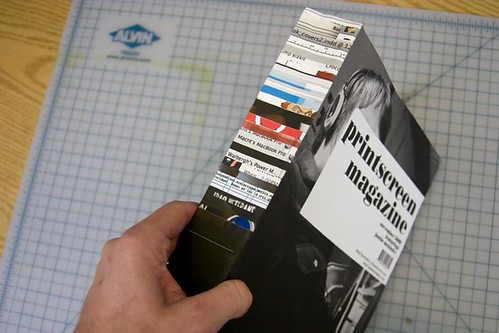
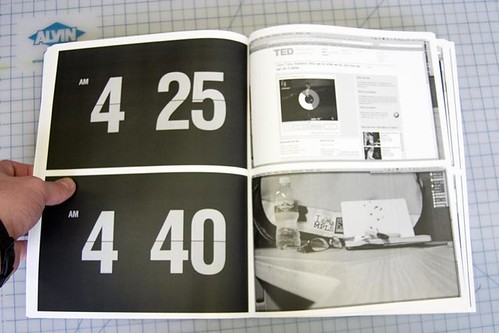
Justin McKinley's Printscreen Magazine
In the Fall of 2008 our very own Justin McKinley did a project for his Web and Screen class where he set up his computer to take a screenshot every 15 minutes. He used the images and data to build a website but also to design a book for his Publications class. The result was impressive - simple yet effective and addictive for its voyeuristic aspect. (It is also one of the heftier books we've bound.)


Subscribe to:
Posts (Atom)
